Fabrication design for a Sewage Treatment Plant (STP) involves engineering a system that integrates physical, biological, and chemical treatment stages into a cohesive, often modular, structure. Modern fabrication focuses on prefabricated, "plug-and-play" units that use materials like Fiber-Reinforced Plastic (FRP) or Mild Steel (MS) with epoxy coating for durability and rapid installation.
Key Components of STP Fabrication Design
A standard design flow typically follows these core structural units:
Inlet Works: Includes a Receiving Chamber to control flow and a Screen Chamber (with bar screens) to remove large debris like plastics and rags.
Grit Chamber: Designed to settle heavy inorganic particles like sand and gravel.
Equalization Tank: Acts as a buffer to stabilize flow rates and pollutant concentrations before biological treatment.
Biological Reactor: The heart of the plant, often utilizing technologies like MBBR (Moving Bed Biofilm Reactor), SBR (Sequential Batch Reactor), or MBR (Membrane Bioreactor) to break down organic matter.
Clarifiers/Settling Tanks: Secondary sedimentation tanks used to separate treated water from biological flocs (activated sludge).
Tertiary Treatment: Includes Pressure Sand Filters (PSF) and Activated Carbon Filters (ACF) to remove residual solids and odour.
Disinfection Unit: Final treatment using Chlorination, UV radiation, or Ozonation to eliminate pathogens before discharge or reuse.
Fabrication Materials & Methods
Prefabricated Modular Units: Often fabricated in a controlled factory environment, these units reduce site disruption and can be installed in just days.
FRP (Fiber-Reinforced Plastic): Preferred for its corrosion resistance, lightweight nature, and lifespan of 1525 years.
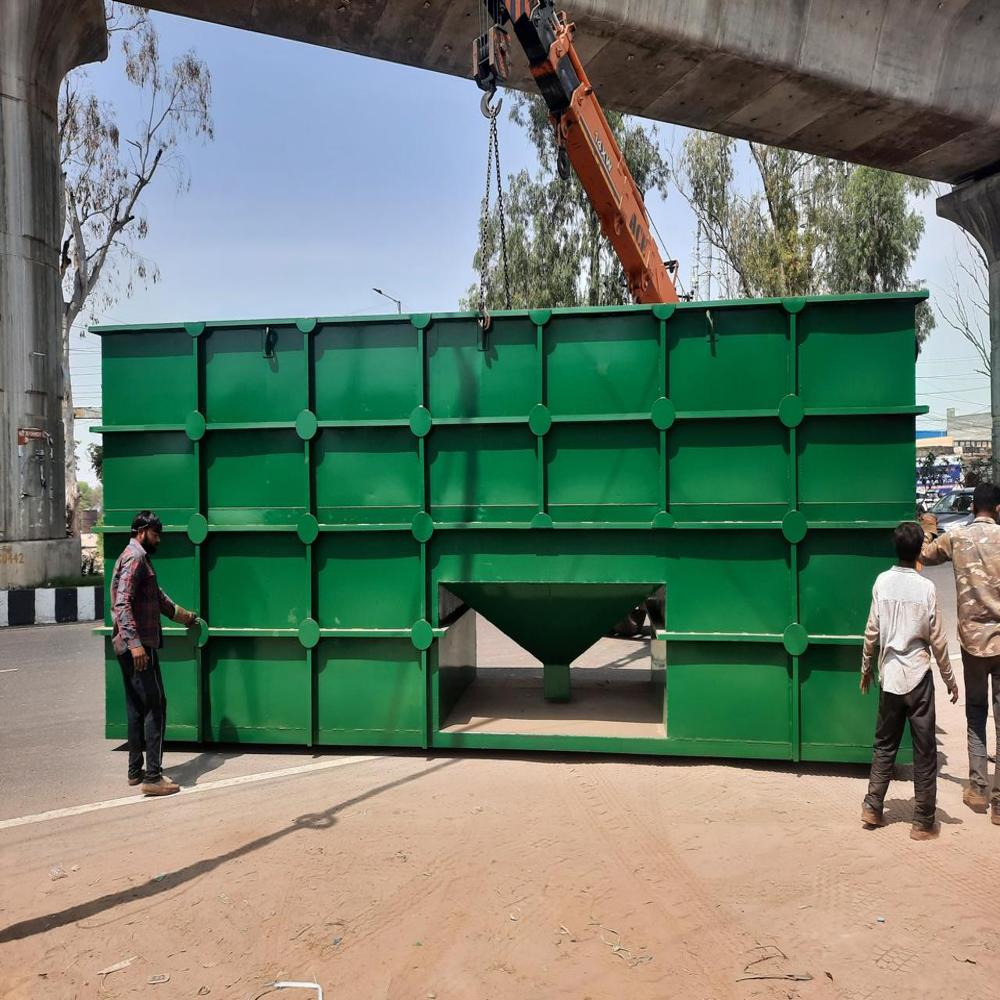
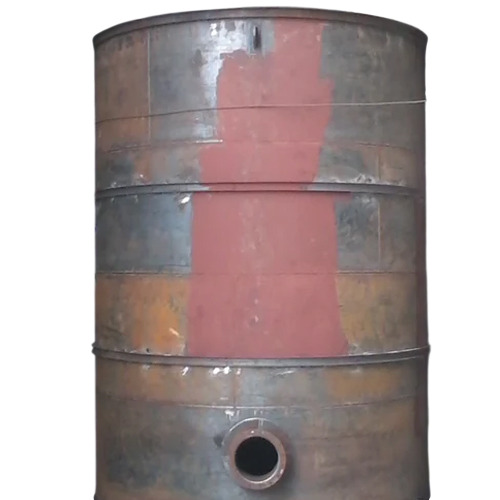
MS (Mild Steel) with Epoxy Lining: Commonly used for larger tanks and clarifiers, requiring specialized internal and external coatings to prevent corrosion.
Compact Design: Modern MBBR and MBR systems can reduce the required land area by nearly 50% compared to traditional concrete plants.
Design Considerations
Capacity Planning: Sizing is determined by peak flow rates and population forecasting, typically measured in Kilo Liters per Day (KLD) or Million Liters per Day (MLD).
Hydraulics: Design must account for self-cleaning velocities (typically 0.62.5 m/s) and gravity-based bypass systems.
Regulatory Compliance: Fabrication must meet standards set by bodies like the CPCB (Central Pollution Control Board) for parameters like TSS (
mg/L) and BOD.
Are you looking for a specific capacity (e.g., 50 KLD or 100 KLD) or a particular technology like MBBR or MBR for your project?
AI can make mistakes, so double-check responses
Packaged STP Plant Design: From Inlet to Clean
Tell us about your requirement
Price:
Quantity
Select Unit
50
100
200
250
500
1000+
Additional detail
Mobile number
Email
Name
Comapny Name
Phone Number
Email Id
City / State
Confirm Your Requirement
Verification Code
Did not receive yet?
Resend OTP
You’re Done!
We have received your requirements and will reply shortly with the best price.

 Send Inquiry



 Send Inquiry


 Send Inquiry